Sunday, 20 October 2013

Acorn Coffee

Acorn Coffee

          Yep thats right coffee made from acorns and this time of year is the perfect time to make this, at first to make acorn coffee seems like quite an involved process but it is actually relatively simple but it does take some effort if, like me, you only use manual methods, after all there`s not much electricity in the field. The methods I describe here aren`t original.  
          To start with you need to do is collect some acorns, obviously, but there are some things that you need to be careful of, 
          First of all ONLY collect acorns that have fallen from the tree, whilst collecting you need to check for for a number of things,
splits in the bottom of the acorn 

a small hole in the acorn (this usually means a grub is living inside)

a split in the shell 

          If these occur or you are just suspicious leave the acorn out of your bag, its better than becoming ill,  
once you have collected enough you need to move on to the next stage which is the float test (from this point on all the photos are taken at home but can be done just as easily in the field), this is a quick simple test that sounds like exactly what it is, putting all the acorns in a bowl of water, those that float need to be removed and discarded. I tend to leave this a few minutes just to be sure.
 floating acorns towards the top

once this has been done the acorns need to laid out to dry, this can be assisted by using the oven (set on the lowest temperature at home or with a warm dutch oven in the field.

for the next part you will need either a light hammer or more preferably a pair of nut crackers (safer) you then need to start cracking and de-shelling the acorns, discard the shells.


again at this stage any acorn that is rotting or you even have slight doubts about discard,

obviously this didnt make the grade

had doubts about this one so I left it out

          The next stage is perhaps the most laborious and if you do plan on making acorn coffee alot I really would recommend getting a grinder preferably hand cranked as there aren`t many power sockets in the field, you now need to grind and sift the acorns, this does take some time so be patient.


          Until you get something resembling flour in the bowl.

           next comes the roasting, for this I have a pan dedicated to tasks like this and it may be wise to have something along the same lines, when you roast the acorn "flour" its best done in a dry pan over a medium heat, the crucial thing here is that you DO NOT STOP STIRRING to prevent sticking, the flour needs to be fully roasted and slightly smoking before taking off the heat, as you will appreciate I didn`t take any photos during the roasting stage just a before and after shot.
before

 after

          from here the next stage, (although this is my preference), is to brew the coffee in a percolator as you would with normal coffee.
  

          Acorn coffee is naturally caffeine free and can be taken with milk and sugar as normal but I would suggest you try it on its own to begin with to gauge its flavour.

          It stands to reason that their are certain species of oak around the world that are not suitable for doing this so best to check before making this. I am also aware that many bushcraft companies will stick to the method of boiling acorns and changing the water constantly to eliminate the tannins within the acorn shells, this was the method that I first used but as I said at the beginning this method is not original and I am actually pleased with the results and have suffered no ill effects from using this method.

Follow the link below to go to the Lone Wolf Mobile Bushcraft website.
www.lwbcfs.com

Sunday, 13 October 2013

Scotland blog (part 3)

Scotland blog (part 3)

          As I mentioned last week this will be the last of my blogs on Scotland and it is about the tent that I used, namely the Wild Country Zepheros 1, it will be a shorter blog than usual as it is a short review.
          I`ve used the Zepheros a few times now but only really overnight, the week in Scotland was the first time I had used it for consecutive nights and whilst I still praise the weight the ease of pitching and the price, there are a couple of things that have disappointed me, don`t get me wrong this is still a good tent and well worthy of purchase but there are things that you would need to be aware of.
          The first issue to be aware of is the headroom within the tent is fairly low and whilst lying down both my feet and head were touching the inner tent which became slightly irritating after a while and may have had something to do with the sleeping mat a had chosen, this wasn`t too much a problem however as at no point did I touch the outer tent so no rain came through.
          The second issue to be aware of relates directly to the first, of course after the irritations of the inner tent I did try to tighten the inner tent both with the straps and buckles designed for the job and by using the pegs on the outside to this as well but unfortunately no matter how much I tried I was still touching the inner tent whilst lying down, I`m sure there`s a way to rectify this and will attempt to do so in the future.
          The third issue is less of an irritation and more of an inconvenience, the zips of the inner tent are a semi circle meaning that to reach out and take hold of something or putting something back from the porch area such as a "waste water bottle" means opening up almost half the tent and letting in cold air, not so much of a problem given the volume of air needed to heat up afterwards but damn inconvenient none the less. this is in comparison to the Hilleberg which has a zip that runs along the level of the ground sheet and doesn`t let any cold air in.
          On the plus side however the issues I flagged up in the blog after I purchased the tent have not happened, althougth the groundsheet is flat it hasn`t so far let any water in, the buckles have not broken and the inner tent is long enough for me.
          I still stand by my purchase of this tent and would still recommend it to anyone if they didn`t have the money for the Hilleberg as long as you are aware of the slight issues with it, I am going to keep mine and I will find a way to keep the inner tent from touching me during the night.

Follow the link below to go to the Lone Wolf Mobile Bushcraft website.
www.lwbcfs.com

Sunday, 6 October 2013

Scotland Blog (part 2)

Scotland Blog (part 2)

          With my new equipment bought and packed and my birthday celebrations out of the way my full attention now turned to to the week I had planned, I had already planned to set off at 5.30 on Monday morning and expected the journey to take between 10 and 12 hours with breaks but as the saying goes "the best laid plans of mice and men" and for some reason that I still cant figure out it took me 11 hours to just get to the border with Scotland, needless to say at this point I was extremely tired, something that became obvious when I nearly ran into the back of truck while using cruise control. an unplanned overnight stop resulted in a surprising result in the campsite at Hoddom Castle just outside Ecclefechan and my first encounter with micro bothy, these self contained huts provide a variety of things and come in 2 and 4 births, unfortunately I didn`t have enough cash on me to stay in one of these and so pitched my tent for the night.


          The next morning I set off and headed further north, once north of Glasgow I started driving along one of the most amazing roads in Britain, the A82, this road winds its way past Loch Lomand and up into the Highlands, my destination was Kinlochleven and I reached it mid afternoon this is where I was going to be camping for the next few nights and is handily situated behind the ice climbing wall. This campsite also had micro bothy`s but they were all booked  


          Once I`d set my tent up I went for a quick pint at the local pub and went for a short walk around the village, I had planned on a walk up to a reservoir but with the light fading I decided against this, there was afterall another day...after my ice climbing session.
          Wednesday was when I had booked my ice climbing session and as it started at 10.30 I had time for a late breakfast.
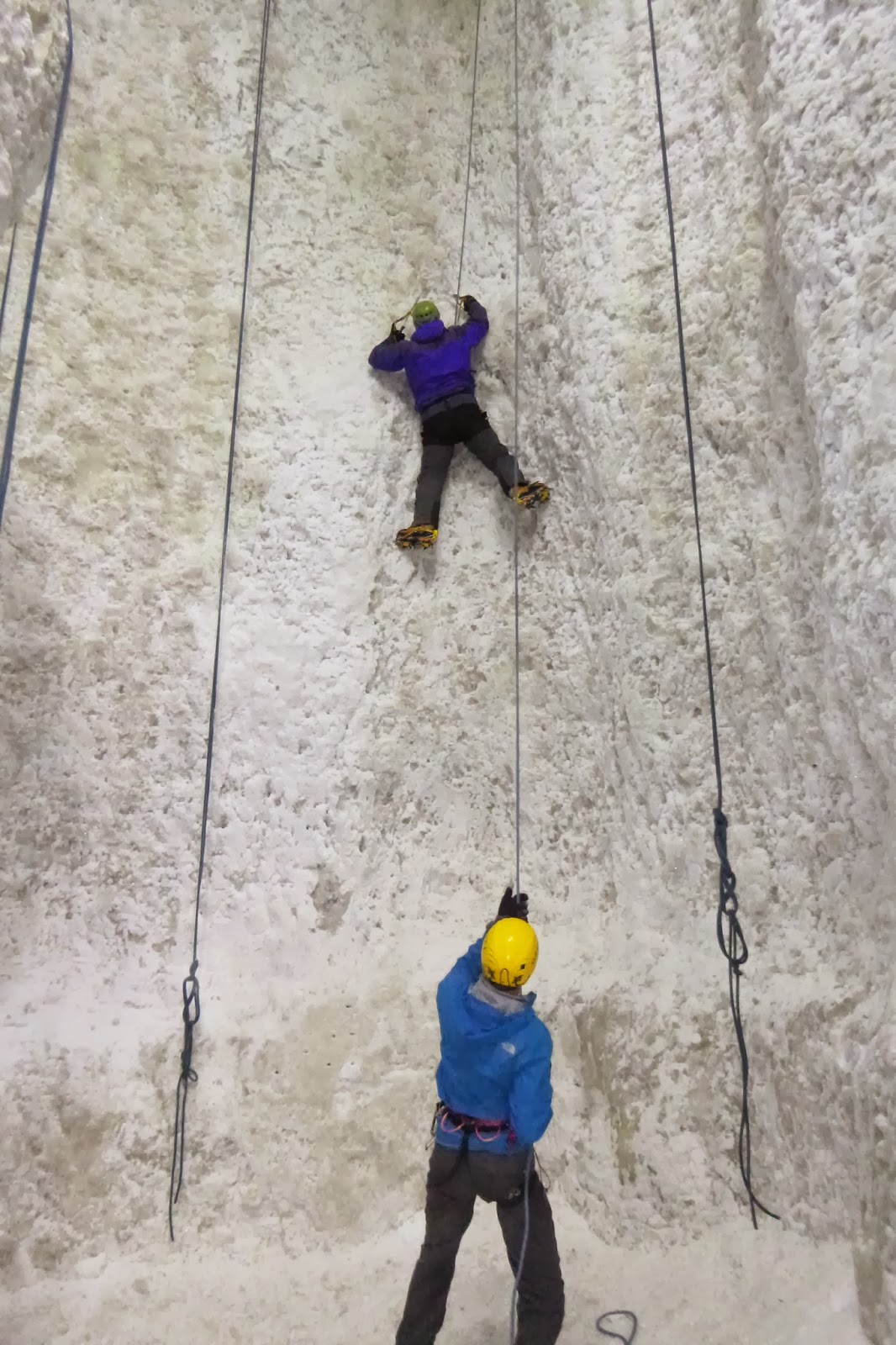
           As I didn`t want to waste any time when I got to the wall I had already dressed appropriately and had been given some strange looks on the way in after filling in the usual paperwork I made my way to the ice wall where I met the person I would be climbing with, after brief introductions the instructor came to meet us and it was time for me to become a student once again.


          As I expected the majority of the lesson consisted of getting confident on the crampons and correct use of the ice axes, compared to rock climbing there is a lot more to remember such as keeping your feet at 90 degrees to the ice face so that both front points of the crampons are driven into the ice, having your feet wide apart when resting and only bringing them together when moving up, looking for ledges to put feet on, learning that massive swing aren`t always necessary when using axes and just as in rock climbing you need to push through your legs rather than pulling on your arms, hard when you`re conscience of the 2 tools in your hands, I did fall off a couple of times I will admit but this was to be expected seeing that I had only been ice climbing once before back in the early 2000s.
          I did find a couple of things surprising during the session, the first being how difficult belaying is, because of the cold in the room the ropes had frozen (obviously) and I was surprised at the amount of effort required to pass the rope through the belay devise and one point the person I was climbing with took a break and weighted the rope, climbing ropes are designed to stretch slightly to absorb impact but even with the rope locked off it stretched at least 18 inches. 
          Something else I found surprising was how hot I got at one point I had to take my glove off and within seconds my hand was steaming, I would have liked to have left my gloves off but knew better than to do this, which had a further impact on my belaying, as most people will testify to belaying with gloves is more difficult as you cant feel the rope and cant feel what its doing and you subconsciously find yourself gripping the rope until muscles start hurting.


          2 and half hours went by very quickly and before I knew it time was up, after a short lunch it was time to decide what to do with my afternoon, I had planned on a couple of small walks, one along part of the West Highland way as it did conveniently run past the bottom of the campsite and one to a local waterfall called grey mares tail, I decided on walking to the grey mare tail waterfall which with a slow walk didn`t take too long to reach, by the time I got back to the campsite once again the light was starting to fade.
          Morning dawned on my last day in Scotland and I spent the early part of the morning packing up my equipment but I was detirmined to go for one last walk even if it was only a couple of hours along the West Highland Way, this well trodden and well maintained footpath runs from Glasgow to Fort William and takes in part of the spectacular Loch Lomand National park, obviously I wasn`t going to be able to do all of it as I had to have left the campsite by 12 noon, but I figure if I started at 9 in the morning and walked south for an hour and then turned around I would at least get a feel for the path and I was right all too soon 10 am came around and I found myself struggling to turn round and head back but I had to, I reached the car just after 11 and pulled my new boots off put my trainers on and said goodbye to the campsite, the run back home seemed to take no time at all and even with a diversion through the Lake District and Penrith I still found myself near York by 7pm, as I still had the rest of Friday to get home I decided as one last splurge on my holiday to treat myself to a motel bed and a trip into York city centre, which it has to be said is one of my favourite cities.

          so that was my week in Scotland, there will be one more short blog next week on using the zepheros tent in Scotland but that will be the last of them, Ice climbing was definitely a highlight as was some of the views from the area, I dont how long it will be before I can get back to Scotland but I hope its not too long 

Follow the link below to go to the Lone Wolf Mobile Bushcraft website.


Sunday, 29 September 2013

Scotland blogs (part one)

Scotland blogs Part One, New Equipment


          As I said at the end of the last blog I have spent the week in Scotland where I did a little bit of walking and had a taster session of ice climbing, but more on this at a later date. I mentioned in a previous blog the need for good boots and as the boot I had have started giving me blisters (see Mersea walk blog) I needed to get some new ones, having had my feet properly measured, which I thoroughly recommend (not just length but width and a couple of other measurements too) I knew that I had `C` width feet, which is quite narrow and that I had a problem with my right foot which is why I use superfeet, so I needed to buy a boot that was narrow but would also take the superfeet insole comfortably and I knew just the boot that would fit the bill, the Asolo Flames(r), I`ve known about these boots for quite some time and have wanted a pair since I first tried them on many years ago but since the boots I had were still serving me well I didn`t really have any excuse to get a new pair, until Mersea.
          Being an Italian brand it comes as no surprise that Asolo(r) are on the narrow side when it comes to boot making, this does mean for me that the boots are a much better fit and more comfortable straight away, the one thing I did have a little trouble with was the top sets of eyelets digging into my ankle but after a few hours this soon disappeared, the only other issue I have encountered so far is one that we all encounter when going from old boots to new and that is the relative rigidity around the foot.


          The sole unit of the boot uses a matrix rubber compound but does incorporate something called the "Asobrake"(r) which is essentially a big rubber lug protruding from the back of the arch support whether this works remains to be seen, the sole unit itself is reasonably rigid and fairly thick meaning these boots should give a long service life.


          Being made of fabric these boots are not naturally waterproof (not always a bad thing) and so have a Gore-Tex(r) lining which should cope with any amount of water thrown at it...until I step in something deeper than the boot.
          The other thing that really makes these boots stand out for me is the locking eyelet, these have started being incorporated on a lot of boots but the ones on the Flames are the only ones I have so far found that actually hold the lace in the same place for the whole day, this means that the boots can be tied tight around the foot have the laces locked in that position and have a little more flex around the ankle if needed. I`m hoping these new boots will last longer than the last boot I bought and seeing they lasted five years these new boots do have strong competition. (I still have my old boots as there is still some wear left in them and as I mentioned I do have hoarding tendencies)

          The other piece of equipment I bought although not as vital as a new pair of boots was still dictated by the end of life of another piece of equipment and that was a new sleeping mat, a few weeks ago I went to a festival and took my old self inflating mat, this mat has served me well in the past and I thought it would continue to do so but unfortunately that wasn`t to be, due to what I assume to be the valve leaking, air was slowly forced out under pressure during the night and I ended up with the worst dead leg from laying on my side all night and not being able to work my leg properly for about 15 minutes after waking up, I`m sure there`s a medical term for this but I don`t know it, I ditched the mat at the end of the festival and started looking for its replacement, it came in the form of the Multi mat(r) Superlite air, this has got to be one of the most remarkable pieces of equipment I have come across, the Superlite Air is a full length airbed that weighs just 300 grams and packs down to the size of about 2 tin cans.


 when fully inflated the 6 cells  give approximately 6 cm of lift, the material used in the construction of the airbed at first feels very light and flimsy but no matter how much I wriggled about and changed position the Superlite air showed no sign of bursting or even deflating, of course with trapped air being a good insulator underneath me combined with a three season sleeping bag and a one person tent led to me becoming too hot during the nights, as with virtually everything in the outdoors there are downsides to equipment and the superlite air does not escape this, the amount of lift created by the airbed meant that no matter how much I adjusted the inner tent my head was still touching it, this was however a minor inconvenience, the biggest disadvantages to the superlite air is the narrowness of the design.


          When lying on my back my arms were off the sides of the bed which for myself wouldn`t be too much of problem as I sleep on my side but for those people that sleep on their backs this may become too much to bear, the other problem with the Superlite air is psychological, I found the first night I used it I was constantly worried about the thing bursting but as I mentioned above this didn`t happen even with 92kg on it (not sure what that is in pounds) obviously this didn`t help with getting a good nights sleep.

          This new equipment will obviously take a little bit of getting use to but should last a fair amount of time before needing replacement.
         
www.lwbcfs.com


Sunday, 15 September 2013

Basic wild foods


Some Basic Wild Foods

          So the nights have finally started drawing in and the days have a definite chill in the air, at least in the northern hemisphere, but before you all start reaching for the blankets and hot soup and resign the autumn and winter to the hardcore mountaineers there are still things to be done and found, this time of year is when some of the easiest wild food comes out.
          Although I will show some of these wild foods it is always best to go with an expert to find wild foods, especially mushrooms and remember to stick to the law when collecting any wild food.

          One of the easiest wild foods to identify is the blackberry, not the mobile phone, where I live there are huge blackberry bushes all over the place with hordes of people raking the berries off, these berries can be eaten as they are or more commonly mixed with apples and baked into a pie, I personally think that everyone should try blackberry picking at least once, trying to convince kids that they are perfectly safe despite not coming from a supermarket is a much harder matter however...that`s for another blog though


          Elderberries are still in season although care must be taken as there are many varieties some of which if uncooked are toxic, easily recognisable these berries have many uses including wines, cordial and marmalades, there are also many folklores surrounding the elderberry, most people will be familiar with this fruit due to the wood being mentioned in a series of books featuring a certain boy wizard or though a liqueur flavoured with berry which also uses it latin name Sambucus 

          Although crab apples by themselves are edible they are extremely sour and wouldn`t be good for this purpose, they are however are excellent source of pectin and can be used as a preserve, the wood like most of the apple family can be used to smoke meat.
(yes the tree is behind a security fence)

          Acorns can also be used for a particular reasons but as they haven`t yet turned brown I cant use them yet.

          As I mentioned above the wild food most people think of this time of year is mushrooms and I cannot stress enough that before going mushroom picking you should go with an expert and for this reason I will not be showing any of them on this blog. There are other wild food avalable at this time of the year and throughout the year, I have chosen the examples above as they are some of the easiest to recognise 
          
          On a different note as a business I am sponsoring a young lady going to Tanzania in Africa with camps international where she will be helping out building school houses/house, as well as giving money I have also given her a micro fleece with the business logo on, as I receive update I will post some on here.


          please note I will not be writing a blog next week as I`m off on holiday to Scotland for my birthday.

Follow the link below to go to the Lone Wolf Mobile Bushcraft website.

The continuing environmental impact of the Beeching Axe of 1963

The continuing environmental impact of the Beeching Axe of 1963

          The continuing arguments over the HS2 project in Parliament has this week led me to dig out one of my old university essays as I think it makes not only an interesting piece on environmental impact but ironically some of the lines mentioned in the essay as being closed down are now being proposed as part of the route for HS2.
          The essay was written early in my university course in the mid 2000s and at the time didn`t sustain a high mark, the essay focuses mainly on the environmental impact and not social so please bear that in mind.

           In 1963 Doctor Richard Beeching issued his now infamous report, in which he proposed the closing of over two thousand stations and five thousand miles of track, this mainly affected the rural branch line network many of which were single track and losing money but also more significantly closed diversionary and secondary main lines, which could have been used to ease the level of road traffic today, I will outline and identify some of these routes later. 
          Going back a little further in history to 1948, the least used branch lines were already being closed down this was being done by the "Branch line committee" with some Three thousand miles being closed by them between 1948 and 1962 and replaced by bus services, this is where the environmental impact starts in earnest as the buses of the time were smaller than they are today, and indeed the railway coaches they replaced, less efficient than they are today requiring more fuel to be used for the same distance travelled, and had no way of eliminating the harmful pollutants released into the atmosphere as the catalytic converter had yet to be invented. 
          With the end of Petrol rationing after the war car ownership increased, however the majority of the population could not afford to buy a car so still made their journeys by rail or bus, with the benefit of only a small amount of pollution being produced per person and lessening the impact on the environment as several people travelled over a small area rather than having to increase road size to permit the same amount of people to travel to the same area.
          In 1955 a Modernisation plan was rolled out across the network which would eliminate steam from the network and be replaced by diesel and electric engines, of course this was done to try and save money and reduce journey times and at first glance this appears to be sound environmental thinking until its remembered what was being replaced with what, while it can`t be denied that steam engines produce alot of smoke the majority of what comes out of the chimney is steam, water vapor, easily reabsorbed by the environment, diesel engines at the time just belched thick black smoke into the air full of pollutants leading to an increase in greenhouse gases the impact of which wouldn`t be felt until much later. 
          Putting aside the infrastructure needed to support electric trains in terms of overhead wires, electric trains although much more environmentally friendly at source still need to be powered by electricity which came from at the time, huge coal burning power stations releasing tons of smoke into the atmosphere once again leading to the increase of greenhouse gases into the atmosphere. 
          After 1963 the wholesale tearing up of the railways began without a thought as to what was to happen next. Without access to the railways they had come to rely on many people had no other choice but to try and afford a car or use buses, still releasing highly polluting gases, and with the increase in car ownership came the inevitable increase in road traffic which led to the building of more roads and ultimately motorways and the beginning of a vicious cycle that we can`t escape from today.
          Whilst it could be argued that this would have happened anyway the impact on the environment would have been lessened as railways would have provided a sustainable alternative in the interim, it would also not have required the vast amounts of land to be destroyed to provide a route for a motorway through areas, such as the M6 through Cumbria or the total destruction of a hill in Oxfordshire for the M40.
           With the increase of car ownership caused (although not solely)  by the Beeching Axe has come the increase in "wasted seating" with the majority of car journeys made by one person, this means the amount of pollution, or carbon footprint, made by one person is huge and although the amount of pollution is increased when more people are in a car as the engine has to work harder, the amount of pollution can be divided by the number of people in the car. Of course there a more seats on a train than a car, anything up to three hundred which when the train is full reduces the carbon footprint of the individual to a very small amount.
          One of the biggest impacts caused by the Beeching axe has been in the area of cargo transport, in 1955 virtually all the stations in the country had at least a siding to hold wagons with goods for the immediate area however the 1955 modernisation began to erode this as one suggestion that was followed through with was containerisation of goods eliminating individual goods wagons and the flexibility in transporting goods they offered, this was compounded in 1963 as the rural branch lines were pulled up leaving communities with no other option but to turn to road hauliers to bring in goods, not only increasing traffic on the roads but also the associated increase in damage to the local environment as well as the environment in general.
          Further the 1955 modernisation plan created huge marshalling yards which were designed to hold and reorganise wagons for onward movement yet because of the amount of goods lost to the roads and the loss of stations and there goods sidings from 1963 these marshalling yards were more or less abandoned in the 1970`s although a few are still being used, the loss of these marshalling yards has also hampered the size of modern goods trains, as during the steam age there are plenty of pictures showing the lengths of some of the goods trains hauled, anything up to a half of a mile long, the length of modern goods trains has shrunk despite modern engines having more than enough power to haul them due to there being no space to store these semi permanently coupled block wagons.
         One area identified by the Beeching report as being money losing was the duplication and under utilization of certain routes, including secondary main lines, a prime example of this being the former Great Central Railway mainline from London to the Midlands, because this duplicated the lines running South to North, it was sited early on as needing to close to save money, a little research shows that this line was built differently to other main lines and could easily have accommodated the modern goods trains of today and most of international wagons as well, as the directors of the line at the time were keen to increase foreign investment and trade to the Midlands. (modern note; does that sound familiar!) If this line still existed today  it would have been able to take a huge amount of goods leaving the other main lines free to concentrate on passenger services and taking more lorries off of the road reducing the environmental impact of these vehicles.
          Another route that was closed due to the Beeching report and could have helped with the environmental impact was the Waverley Route running from Carlisle to Edinburgh through the Scottish borders, not only was this line used by the isolated communities as the primary means of getting around but in at least one case was the only way of getting anywhere, further to this the route was used as a diversionary route for freight trains on a regular basis and had a regular freight working to the communities over the line, after the Waverley was dismantled the A7 road had to be upgraded to cope with the increase of road traffic supplying to the communities and today can be regularly clogged with forty tonne lorries winding their way round the roads, the biggest irony being that for the vast majority of its length the A7 follows the route of the Waverley line.
          A further line that could be used today would have been the Somerset and Dorset line in the South West of England running from Bath to Bournemouth, this did have the distinct disadvantage of being single track for the majority of its length but as an alternative means of getting a large quantity of goods down to the South West of England, unclogging the M5 and reducing the impact on the environment in the area.
          Another line that could potentially be useful today would have been the branch line running from Penrith to Keswick, this once again was torn up and replaced by a road that follows virtually the same route through the Cumbrian countryside, this line would have been particularity useful in the summer months to take tourists from Penrith to Keswick, there are not enough car parking spaces in Keswick for all the tourists that come through nor is there the land to expand into to create more spaces, this may have been negated had the railway line still been in place.
          Above I have outlined just four of the potential routes that could have been used in the present day to reduce the impact on the environment but were dismantled for various different reasons.
          Although devastating from a socio-economic point of view the Beeching axe has also had a devastating impact on the environment that is continuing to be felt today, unfortunately this impact is unlikely to be reversed as the lines have been concreted over or built on, station siding no longer exsist for goods and trains are now formed into block formations.

          As I mentioned at the start, not very good as it was biased and woefully short of references or statistics (only a best guess can be made for some of these old routes), all cut out here, but it is relevant to the arguments going on in parliament now, Thankfully since I wrote it some changes have occurred, part of the Waverley line has been rebuilt and there is discussions going on about rebuilding the line between Penrith and Keswick, its doubtful whether this will have any impact but its a start. Its also worth mentioning that ironically the government (conservative) that closed these lines is the same government proposing using part the Great Central Railway route as part of the HS2!
          I personally do not support the HS2 as not only is it a waste of money but a huge environmental disaster waiting to happen.

Follow the link below to go to the Lone Wolf Mobile Bushcraft website.
www.lwbcfs.com

Sunday, 8 September 2013

Mersea Island walk

Mersea Island walk

          Mersea Island lays nine miles south east of Colchester, and is situated in the estuary of both the Colne and Blackwater rivers the only way on to the island other than by boat is by a causeway known as the Strood, although short the Strood has been a constant barrier onto the island for hundreds of years and would prove an inconvenience, although not a huge one, to me at the end of my walk as well.
          The walk is actually described in an issue of TGO magazine and as it was only a few miles away I decided to do it, so with my bag packed and the tide tables checked I set off.
          As usual I would have run keeper, and the robotic voice announcing my progress every hour (I swear that voice gets more condescending every time I use the app). Parking in West Mersea I started walking in a clockwork direction around the island with the coast on my left hand side. West Mersea has been known for its oyster beds since the Roman period and Mersea oysters are still sold in Colchester today, empty oyster shells can be found in areas on the side of the road leading down to the foreshore of West Mersea,


          A diversion from the route described Led me away from the shore briefly and into the interior of the island after which I dropped down close to the Strood, even though there was still a few hours until high tide the water around the Strood was getting high and would soon cover the roadway, as I continued to follow the route I came across a worrying sign,

The Strood 


          Could this mean my walk would have to end earlier than expected? thankfully no, the sea wall may have been breached but the path had been rerouted further south, this meant that although I wouldn`t be following the exact route I would still be able to complete my walk. from here the walk became much flatter as it did stick close to the shoreline following the Pyefleet channel all the way around the East Mersea.


          With a pace of 4.8KPH I soon reached the furthest easterly part of the route and took a little lunch before starting on the south side of the island, unfortunately the weather decided it would change at this point and what had been a pleasant walk soon became a battle against the rain, it didnt however dampen my spirits nor my pace, what would though would be the blister that had started to form on my heel and as I suspected my pace slowed to 4 KPH, not that it mattered overly much as at this point I was nearly back to the car anyway.
          With my slower pace I knew I wouldn`t be able to make the causeway before the Strood was covered and so did that most British of things, popped into a cafe, had a cup of tea and waited for the tide to drop, which would happen within the hour.
           

          As my boots are now starting to give me blisters its time I consider buying some new ones, oh the decisions, new Salomon`s or Asolo`s or Marmots!

          This walk although easy does require a good pair of boots as well as all the usual the equipment and I would recommend it to anyone wanting an easy walk or introduction to walking.

Follow the link below to go to the Lone Wolf Mobile Bushcraft website.
www.lwbcfs.com